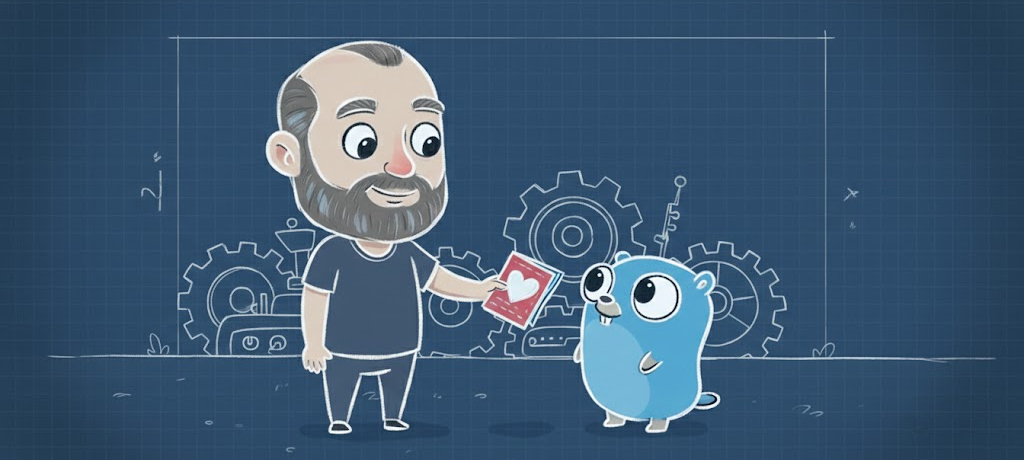
Hi. 👋
I’m Jon Sykes and I’ve been writing code since I was 12. I drew my first circle using QBasic in a command prompt on a Gateway Desktop running Windows 95 and an Intel Pentium II processor. Since then I graduated, started my career as a software engineer, went on to design and implement a micro-service architecture for a popular online retailer, and eventually moved on to running my own engineering teams.
Who am I? Why should you read my blog?
I started back in 2007 as a .NET Developer writing internal tools like Master Data Management and Contractor Routing systems. Extremely boring work, but it taught me a lot about software architectures and databases. I eventually moved on to a Silicon Valley based company, Fanatics and found my love of Go.
I’ve since left Fanatics and continued my career, but through my time at these companies I’ve learned a few key principles I try to live by today:
-
Never work for a company that doesn’t center its business on the technology. Companies who view IT as a cost center are always going to think of technology as a burden to the business instead of a key driver of the business. These companies tend to struggle over time and have trouble growing. This varies by industry of course…
-
There are two types of technology organizations. Organizations that value team autonomy, which tend to have faster delivery velocity, but siloed architectures. Organizations that have rigid architecture governance, which tend to move much slower with somewhat consistent product implementations. The correct answer is to have an organization that lives somewhere in the middle.
-
When managing a team of engineers, don’t let your technology biases control the flow of design within your team. Share your experience, but foster your engineers’ ideas to help them grow as individuals.
-
Go is the best language for backend development. Fight me.
What will I be writing about?
I’ll mostly be writing about the things I’m passionate about, which happens to be a lot of things, but I’ll try and keep it engineering focused.
- Modern takes on software architectures
- My open source project Weave Labs
- AI benchmarks and experiments
- How to use AI in a practical production environment. Safely.
- Technology focused philosophical rantings and ravings
- Did I mention I like Go?
I’ll try and do a post at least once a month and keep everyone notified via X/Twitter.
Speaking of Philosophy… What’s my take on AI?
😬
To understand my ever-evolving opinion of AI, you have to understand one of the key tenets I’m striving to fight against with this blog.
The Dead Internet Theory
Wikipedia defines “dead internet theory” as the assertion that the internet (since around 2016) has consisted primarily of bot activity and automated content manipulated by algorithmic curation. For a while, this was all considered a conspiracy theory. Of course it always had some level of truth to it, especially since the rise of interest based content filtering (the algorithm) that drives every social media app. The truth is, until the mainstreaming of LLMs, human content was still the life blood of the internet, it was just being algorithmically distributed to the masses in the most efficient way possible to keep people’s eyes glued to their screens.
I’m not really saying anything here that most of you don’t already know, but I think it’s an important opener to understand why I’ve decided to create a blog in 2026.
I mean, if you think about it, this form of writing has really changed little in over 3 decades. It’s basically a classy version of a Geocities web page from 1996. If you don’t know what that is, it was a thing that existed before MySpace, and if you don’t know what that is… well, let’s just say I’ve been around long enough to have strong opinions about table-based layouts.
I wanted to start writing things down in my own words and sharing them out to people, partly because I’m starting a new open source project, but also because I want to prove that there are still people out there writing new stuff, even if it’s becoming less true every day. Don’t get me wrong, I’m a proponent of using AI as a tool. I truly believe it’s a technology that can help humans remove the noise and focus on solving difficult problems. In fact, I hope to share a lot of my AI knowledge and experience in this blog.
However, I think it’s important we create some boundaries. I’m not going to dictate boundaries for others, you use the tools how you want to use them. But I’ll lay out some guidelines for myself, for this blog, and anything else I create.
My Personal AI Guidelines
-
Always disclose your use of AI on any content that’s created or edited by AI. This disclosure should include how AI was used in the production of that content.
-
It’s acceptable to use AI as a tool to make developing, editing, and expressing your original thoughts, designs, and practices more efficient.
If you could create the same code in 30 minutes that took the model 2 minutes to create, you’re probably using the tools as they should be used.
-
It is NOT acceptable to use AI to wholesale generate content, that will be shared publicly, that does not have a strong foundation in your original thoughts, designs, or practices.
If you had a model generate a blog post after writing a single sentence prompt, you should probably stop and think through what value that is really adding.
-
It isn’t acceptable to use AI to mimic any form or expression of a person’s likeness or voice.
If you asked the model to narrate a video using Samuel L. Jackson’s voice then you are intentionally stealing from a real person. And no it’s not ok if they’re dead.
-
It’s acceptable to use AI for image, audio, and video generation with the following caveats:
- Your prompts should NOT contain individual artists names or works to drive the generation of the content you are requesting. “In the style of Studio Ghibli” or “In the Style of Starry Night” specifies clear intent to rip-off someone else’s work and you shouldn’t do it, it’s tacky.
- You use built-in trained voice models to generate audio. It’s also acceptable to train your own voice or the voice of an individual as long as it’s consensual.
- You’re enhancing your owned video recordings with special effects or in place of manual editing.
These are my rules, they’re incomplete, and I reserve the right to change these rules. I’m a human, and I get things wrong. But for the most part I think these rules represent my current take.
I mean… if you ever see something like “I have decided to let AI control my life, raise my kids, manage my bank accounts, and run my business”, then you should probably make sure I am still alive and a T-1000 unit hasn’t completely taken over my life…
But what about intellectual property?
If I had a time machine, and I could go back and make all the big players in the AI world reconsider their use of stolen intellectual property in the training of their models… It wouldn’t have made a bit of difference. There isn’t a sentence you or I could have spoken or a switch we could have flipped to change their minds. The emergent technology wouldn’t exist without all the data they used to train it.
Also… If I had a time machine, I wouldn’t use it to go back to 2016 to try and talk Sammy into not pirating the entire internet. There are so many more interesting times I’d go back to. I mean… Dinosaurs. Am I Right?
Does it mean they shouldn’t pay for it? Absolutely not, I hope to see more IP holders get payouts for unlicensed use. More importantly, we should introduce solid regulations and enforcements for data used to train large language models.
In short, AI is a tool and should be used as such. We should strive to maintain ethical usage guidelines where we can and within the scope of the world we can reasonably control.
What’s next
- Is Qwen 3 Coder Next the first local model that’s able to do real agentic coding?
- Breaking down the architecture of the AI Assistant with the naming crisis — a deep dive into the Clawdbot/MoltBot/OpenClaw stack.